
A New Home for Clinical Confidence: MNR Opens the Learning Hall Complex and MNR CLINOVA Simulation Lab
Home / MNR Educational Trust / A New Home for Clinical Confidence: MNR Opens the Learning Hall Complex and MNR CLINOVA Simulation Lab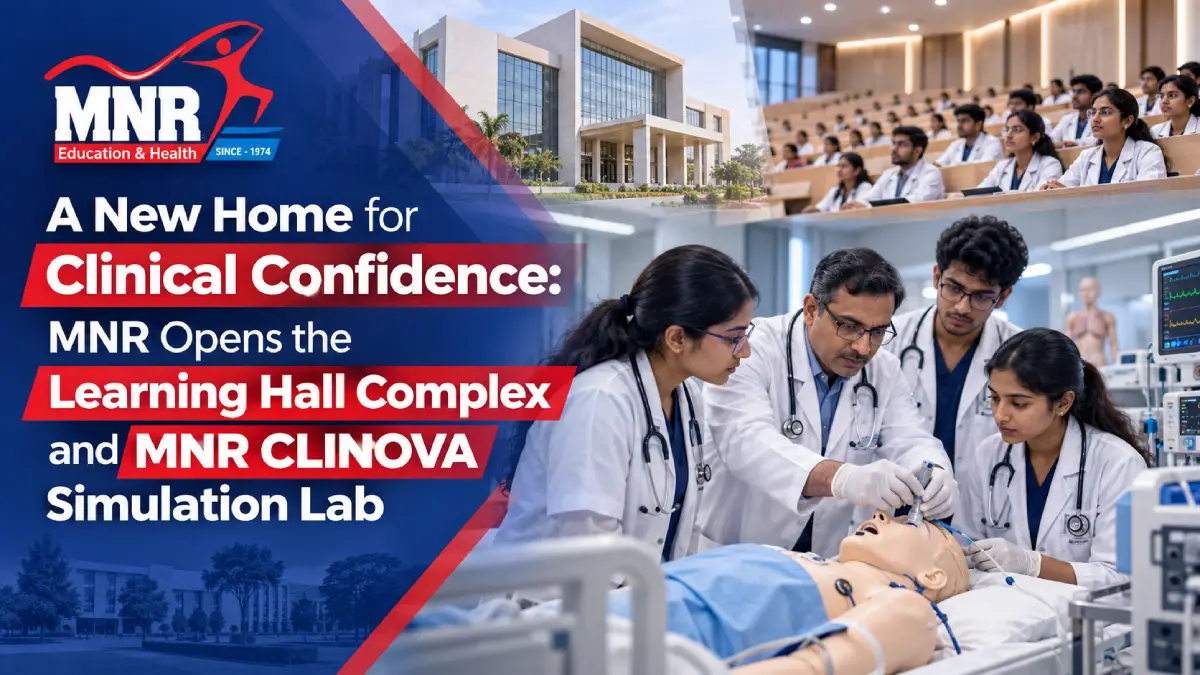
On Thursday, 17 September 2026, in its Silver Jubilee year, MNR Medical College & Hospital opened two facilities that change how its students will learn medicine: a Learning Hall Complex of four 300-seat lecture theatres, and an advanced skill and simulation laboratory named MNR CLINOVA. Sri C. Damodar Rajanarsimha, Hon’ble Minister for Health, Medical & Family Welfare, Science and Technology, Government of Telangana, inaugurated both as Chief Guest.
Every doctor remembers the first time. The first cannula. The first airway. The first call taken alone at three in the morning, when a patient’s blood pressure will not hold and the decision belongs to nobody else.
For generations of medical students, that first time happened on a living person.
At MNR Medical College & Hospital, it will now happen somewhere else first — in a room built for that exact purpose, on a mannequin that breathes, bleeds and deteriorates the way a patient in trouble does, with a teacher beside the student to talk through what went right and what did not.
That room is called MNR CLINOVA. It opened on Thursday morning, alongside a new complex of lecture theatres, at a ceremony held at the MNR Auditorium on the MNR University campus at Sangareddy.
A morning that marked twenty-five years
The inauguration began at 10:00 AM on 17 September 2026. Sri C. Damodar Rajanarsimha, Hon’ble Minister for Health, Medical & Family Welfare, Science and Technology, Government of Telangana, was the Chief Guest.
Sri M. N. Raju, Chairman of MNR Educational Trust and President of MNR University, was Chief Patron of the programme. Sri Ravi Varma Mantena, Vice-Chairman of MNR Educational Trust and Chancellor of MNR University, was Patron.
The timing carries its own weight. MNR Medical College & Hospital was founded in 2001 with a single batch of 100 MBBS students. Twenty-five years later it admits 250 undergraduates and 143 postgraduates a year across the broad specialties, and runs a 1000-beded teaching hospital serving the rural communities around Sangareddy. The college is among the few medical colleges in India accredited by NAAC with an “A” grade.
Four Halls, Twelve Hundred Seats
The MNR Learning Hall Complex holds four lecture theatres. Each seats 300 students, which puts 1,200 seats under one roof.
Every theatre is air-conditioned, with proper seating and current audio, video and lighting systems. That description sounds ordinary until one has sat through a ninety-minute pathology lecture in the back row of a hall where the projector washes out and the speaker does not carry. Students in the last row now see and hear what students in the first row do. For a college teaching 393 students a year across UG and PG, that is not a small thing.
MNR CLINOVA: The Room Where Mistakes Are Welcome
The centrepiece of the day was MNR CLINOVA — Advanced Skill & Simulation Lab.
Simulation training rests on one idea. A student should meet a crisis for the second time when they meet it for the first time.
CLINOVA gives medical students, interns, postgraduate residents, nurses and other healthcare staff a controlled place to rehearse clinical work before they carry it to a bedside. The lab brings together high-fidelity patient simulators, advanced procedural trainers, task trainers and technology-led simulation platforms. A simulator can be made to lose its airway, throw an arrhythmia or slide into shock, then reset and run again until the trainee gets it right.
The difference from a textbook is pressure. A student who has read the algorithm for cardiac arrest knows the sequence. A student who has run that algorithm on a deteriorating simulator, with a clock running and a team waiting on their instruction, knows something else entirely.
What trainees will practise inside CLINOVA
| Clinical area | What a trainee actually practises |
|---|---|
| Basic and Advanced Life Support | Chest compressions, defibrillation and the full resuscitation sequence, timed and assessed |
| Airway Management | Securing a breathing passage under pressure, including the airways that will not open easily |
| Emergency Medicine | Sorting, stabilising and deciding quickly when several things are wrong at once |
| Critical Care | Managing the sickest patients — ventilation, monitoring and the deterioration nobody saw coming |
| Trauma Management | The first minutes after an accident, when the order of actions decides the outcome |
| Obstetric Emergencies | Complications in labour, where two lives depend on one set of hands |
| Neonatal Care | Resuscitating and caring for a newborn, where the margins are smallest |
| Cardiology Procedures | Cardiac procedural skills, rehearsed step by step |
| Clinical Examination and Procedural Skills | The everyday work — examining properly, and performing procedures cleanly and safely |
| Other medical and surgical skills | Further procedural training across disciplines as the curriculum requires |
Training the team, not only the doctor
One emphasis at CLINOVA deserves particular attention: simulation-based team training.
Most clinical emergencies are not solved by one person. They are solved by a group — a resident, an intern, two nurses, a technician — working in the same small space under time pressure. When that group fails, it usually fails on communication rather than on knowledge. Somebody assumed a drug had been given.
Somebody did not say out loud what they were about to do.
CLINOVA lets medical students, interns, postgraduate residents, nurses and other healthcare staff run these scenarios together, as the team they will actually be. The lab is built to develop communication, teamwork, leadership, coordination and clinical decision-making, and to build the habit of patient safety early, while the stakes are still artificial.
Why this matters beyond the campus
MNR’s teaching hospital serves a largely rural population, with around 350 doctors providing care around the clock across 760 beds. Every trainee who walks out of CLINOVA more confident walks into those wards.
The facility also gives the college a dedicated home for competency-based medical education, for continuing professional development, and for structured clinical skills training — the three things regulators and patients alike now expect a medical college to do properly rather than incidentally.
| 2001 | The year MNR Medical College & Hospital was founded, with 100 MBBS seats |
| 250 | MBBS seats a year today |
| 143 | MD / MS postgraduate seats a year, across the broad specialties |
| 1000 | Beds in the teaching hospital |
| 350 | Doctors providing round-the-clock care, approximately |
| 4 | Lecture theatres in the new MNR Learning Hall Complex |
| 300 | Seats in each lecture theatre — 1,200 across the complex |
| 85 | Acres of the MNR Higher Education and Research Academy campus |
| 25 | Years of MNR Medical College & Hospital, completed in 2026 |
One Campus, Eleven Institutions
CLINOVA sits inside the MNR Higher Education and Research Academy at Sangareddy, an 85-acre campus with over 25 lakh square feet of built-up area. Medicine, dentistry, homoeopathy, physiotherapy, nursing, pharmacy, engineering, arts, science and education are all taught on the same ground, which makes it among the largest private educational campuses in Telangana and Andhra Pradesh.
That matters for a simulation lab in one specific way. Team training needs a team. A campus that already trains doctors, nurses, physiotherapists and pharmacists within walking distance of each other can put a genuinely mixed group into a scenario, rather than assembling one on paper.
A legacy that started with thirty-six children
MNR Educational Trust began in 1974 with a primary school of 36 students in Hyderabad. Today it governs 42 institutions with around 40,000 students and approximately 1,800 faculty members, across Telangana, Maharashtra, Dubai and Sharjah.
The Trust marked its Golden Jubilee on 20 December 2023 at Parade Grounds, Secunderabad, with the Hon’ble President of India, Smt. Droupadi Murmu, as Chief Guest.
Its founder, Sri M. N. Raju, began his working life as an office boy at a degree college in Bhimavaram. Encouraged by his principal, he completed his SSLC while working, moved to Hyderabad as a primary school Telugu teacher, and took two postgraduate degrees through non-formal education during seventeen years of service. The phrase the Trust has used ever since — enriching lives through education and health — reads differently once that story is known.
Conclusion:
The Trust and MNR University are working towards a broader, multidisciplinary campus in the spirit of the National Education Policy 2020. Planned additions include Schools of Management and Law, Design, Life Sciences, Indian Knowledge Systems, Technology-led Agriculture, Community Wellness and Lifestyle Management, and Energy Studies, along with a Centre for Research and Innovation.
For now, the news is simpler and closer to hand. Four halls where every student can see the board. One room where a young doctor can get it wrong, understand why, and get it right before it counts.
Apply Now: https://mnrindia.org/apply/
Related Blogs

How Para-Medical Courses After 12th Prepare You for High-Pressure Medical Roles
“There is no higher honor than to be given the responsibility to care for another…
TSDC 2026 and the New Direction of BDS Colleges in Telangana
Introduction The Telangana State Dental Conference (TSDC), held recently in Hyderabad, witnessed significant participation, with…